
What is a holding environment
The concept of holding environment comes from the work of Donald Winnicott. He described how an infant develops a sense of safety through being “held”, both physically and emotionally by the stable presence of a parent or caregiver.
This experience of being supported and cared for, together with the containment of the child’s emotions, creates in the nervous system a fundamental sense of security. A very similar mechanism can be observed in coherently designed spaces.
When architecture has a clear rhythm, vertical elements, a repeating structure and well-defined boundaries, the body perceives it as a supportive framework and the nervous system reads such an environment as a stabilizing frame for the body in space.
Vertical elements function almost like a visual equivalent of arms or the spine of the space helping to stabilize the body’s orientation, reduce perceptual chaos, and provide a clear point of reference.
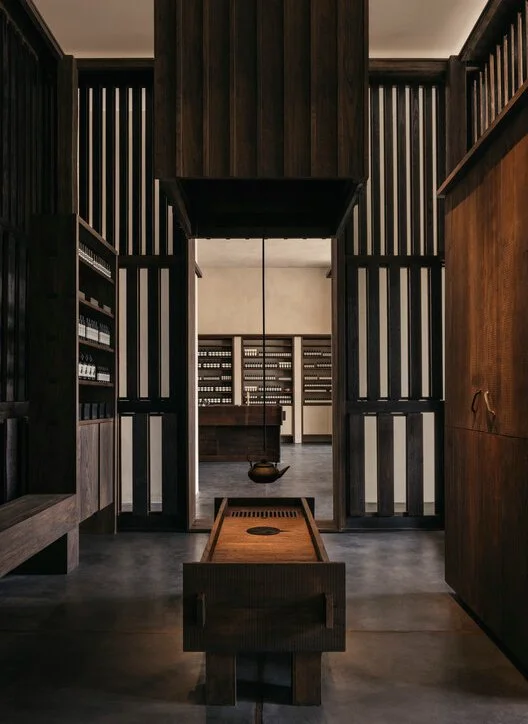
The feeling of being held
Look at this interior once again. The feeling that appears is exactly the one I’m describing: the sense of being held by something bigger.
Much like a child in the arms of a calm adult, when the nervous system recognizes rhythm, predictability and structural stability.
The body receives a signal of safety.
“When an infant is physically held, it senses through its body whether it can rely on the parent for support. If the caregivers lack inner stability and grounded presence, if they are emotionally unavailable, the child stiffens its spine to support itself, which leads to tension in its body.”
Julianne Appel-Opper
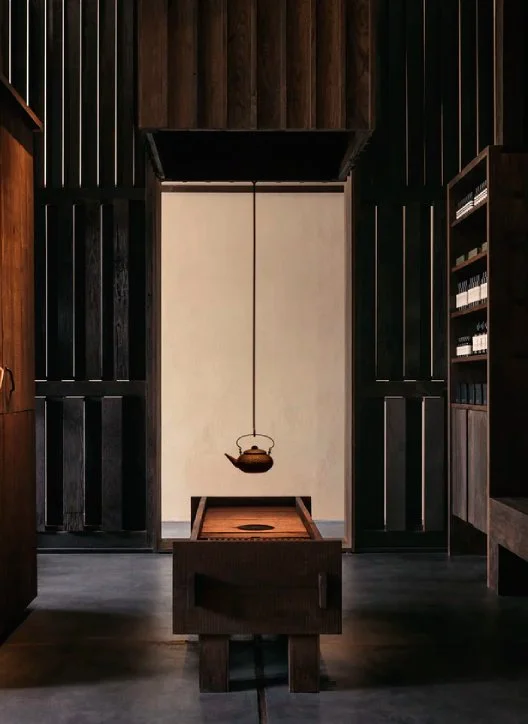
Regulation through form
Regardless of scale, when a form possesses rhythm, weight, stability and a clear structure, the body responds in a similar way.
The eye moves across the surface in a predictable rhythm and the nervous system reads this structure as stable and soothing.
This primal sense of regulation does not arise from decoration.
Not from the organization of function.
It appears when a space or object recreates the experience of being held.
An external equivalent of a regulating relationship.
Words by Ines Lulkowska
Photography courtesy of Aesop Bangkok
